A few years ago this article could speculate. Now generative tools can produce a plausible song from a sentence, most distributors ask whether a release contains AI audio, and every musician has an assistant that can draft a pitch email in seconds. The question isn’t whether AI is part of a music career. It’s where you put it.
This guide draws that line: what to hand over, what to keep, the rules that now apply, and how to build a workflow where the tools make you more of an artist rather than less. It’s an opinion, and it’s mine: the tools are servants, not masters, and the artists who get the most from them decided that on purpose.
Where AI is simply better than you
There’s a category of work that drains creative energy and adds nothing artistic. This is where automation belongs, and resisting it is a cost with no upside:
- Drafts. The pitch email, the press note in two lengths, the twelve captions for one clip, the grant application. A first draft in seconds that you then make yours.
- Research. Which playlists fit the song, which venues in a city book your size, what a distributor’s terms say, how a royalty society works.
- Planning and admin. Release timelines, tour budgets, the checklist you’d otherwise rebuild each time, the tasks a confirmed show creates.
- Transcription and notes. Sessions, interviews, voice memos turned into searchable text.
- Technical assistance. Stem separation, a reference mastering pass, tidying a session, finding the take where the timing drifted.
- Analysis. Reading the numbers across platforms and telling you what changed.
The test is simple: if the task has a right answer and no signature, hand it over. If a fan couldn’t tell whether you or a machine did it, and wouldn’t care, it isn’t where your hours should go.
What stays human
The other category is the reason anyone listens to you in the first place:
- The song. Writing it, deciding what it’s about, the melody that only you would have found.
- The performance. The take, the voice, the timing, the room.
- The final creative decisions. Which mix, which artwork direction, which single leads. Tools can propose; you choose.
- The story. Why the song exists, in your words.
- The conversation. Replies, messages, the moment at the merch table. People can tell, and they mind.
None of this gets more efficient with automation. It gets less valuable. In a feed where anyone can generate anything, a specific person making specific decisions is the only thing that can’t be reproduced, and it’s the thing people follow.
The rules, as they stand in 2026
The legal and platform landscape is moving, so treat this as a snapshot and check before you rely on it.
Copyright. Several major jurisdictions, including the United States, have taken the position that material generated entirely by AI, without meaningful human authorship, isn’t protected by copyright, while work where a human made the creative choices can be. If generative tools touch a release, keep a record of what was human and what wasn’t.
Disclosure. Some distributors and streaming platforms now ask whether a release contains AI-generated audio, and several have policies on labelling or restricting it. Read your distributor’s terms. Be honest where asked. Assistance in mixing or admin is treated differently from generating the recording itself.
Training and consent. Whether your recordings can be used to train generative models, and whether you can opt out, varies by platform and territory. It’s worth knowing what your distributor and your PRO have said on it.
Voice and likeness. Cloning a real artist’s voice without permission is restricted in a growing number of places and against most platforms’ rules regardless.
None of this stops you using the tools. It means using them with your eyes open.
Building the workflow
The artists who benefit aren’t the ones with the most tools. They’re the ones who built a repeatable way of working where the tools have a fixed place. Three principles:
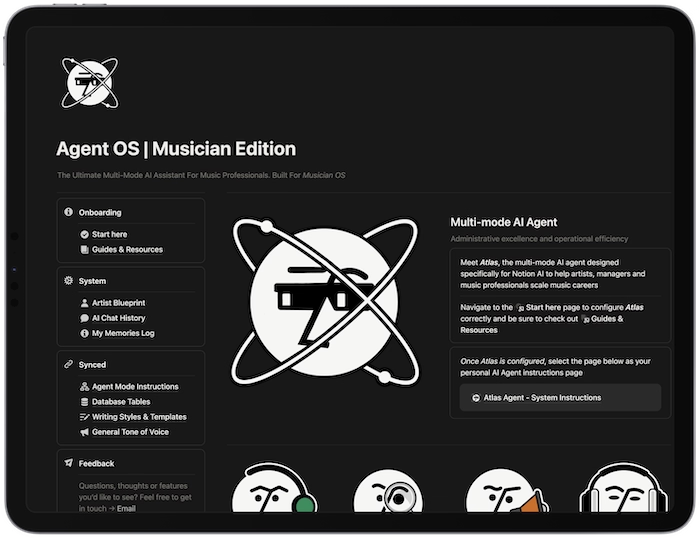
Give the tool the context once. An assistant that knows your bio, your catalogue, your release calendar and your voice writes a better draft than one starting from nothing every time. This is why an assistant inside your workspace beats a chat window: it can see the projects and the tasks. Notion Agent OS is built on that idea, with eight pre-built modes (operations, research, marketing and content, songwriting, release, visual and brand, career coach, legal) running on Notion AI, which needs a paid Notion AI plan.
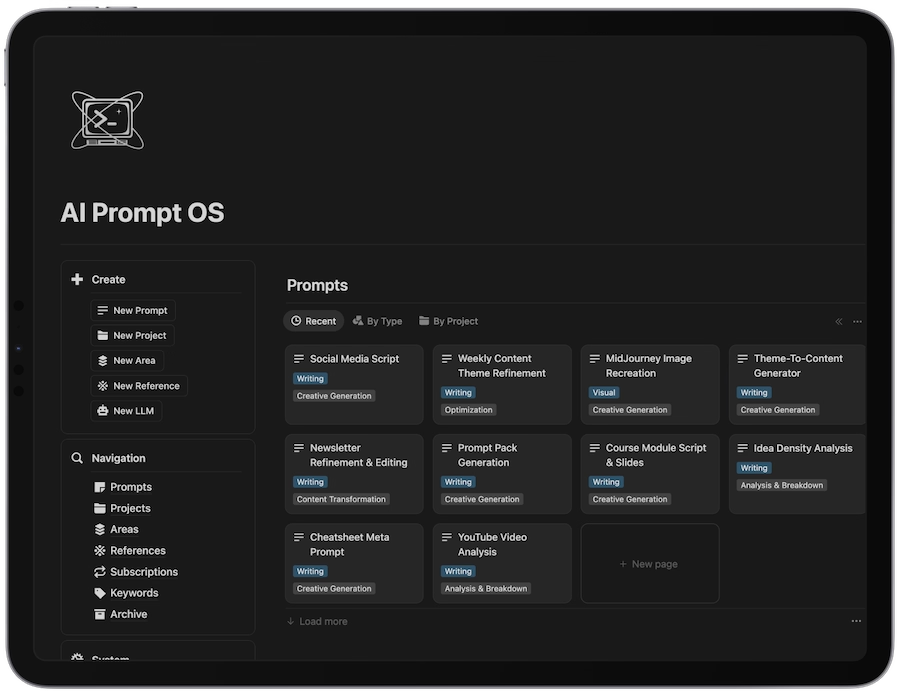
Keep the prompts. A good prompt for a pitch email or a caption set is an asset. Version it, reuse it, improve it. The AI Prompt OS exists for that: a library with projects and versioning, so the prompt that worked last release is there for the next.
Judge by hours. Every month, ask which tools handed back time for the music and the audience, and which just added a step. Drop the second kind without sentiment.
The practical questions
Before adding any tool, answer these:
- Which tasks drain me and add nothing artistic?
- Where would an hour back each week go?
- Is this tool amplifying something I do, or replacing it?
- What do I need in place so quality holds as the volume grows?
The answers are different for every artist, and they’re the whole strategy.
The point
The rise of these tools isn’t the end of human creativity. It’s a sorting. The mechanical work is leaving the artist’s day, and what’s left is the part that was always the job: making something specific, and saying why. Let the machines have the routine. Keep the remarkable.
Frequently asked questions
How can musicians use AI without losing their sound?
Use it for the work around the music rather than the music itself: drafting pitches and captions, research, planning, admin, transcribing sessions, first passes at artwork ideas or scripts. Keep writing, performing, the final creative decisions and the conversation with fans human. The line is a choice, and the artists who benefit most are the ones who drew it deliberately.
Can AI-generated music be copyrighted?
As of 2026, the position in several major jurisdictions, including the United States, is that material generated entirely by AI without meaningful human authorship is not protected by copyright, while a work where a human made the creative decisions can be. Rules differ by country and are still moving, so if you use generative tools in a release, keep a record of what you did and check the current guidance before relying on it.
Do I have to disclose AI in my music?
Increasingly, yes. Some distributors and streaming platforms now ask whether a release contains AI-generated audio, and several have policies about labelling or restricting it. Read your distributor's terms before uploading, and disclose honestly where asked. Using AI for mixing assistance or admin is a different matter from generating the recording, and the platforms treat them differently.
What are the best AI tools for independent musicians?
The useful ones are mostly not music-specific: a general assistant for drafts, research and planning; an assistant inside your workspace that can see your projects and tasks; transcription for sessions and interviews; and stem separation and mastering assistants for technical work. Pick one or two, build them into a repeatable workflow, and judge them by the hours they hand back.