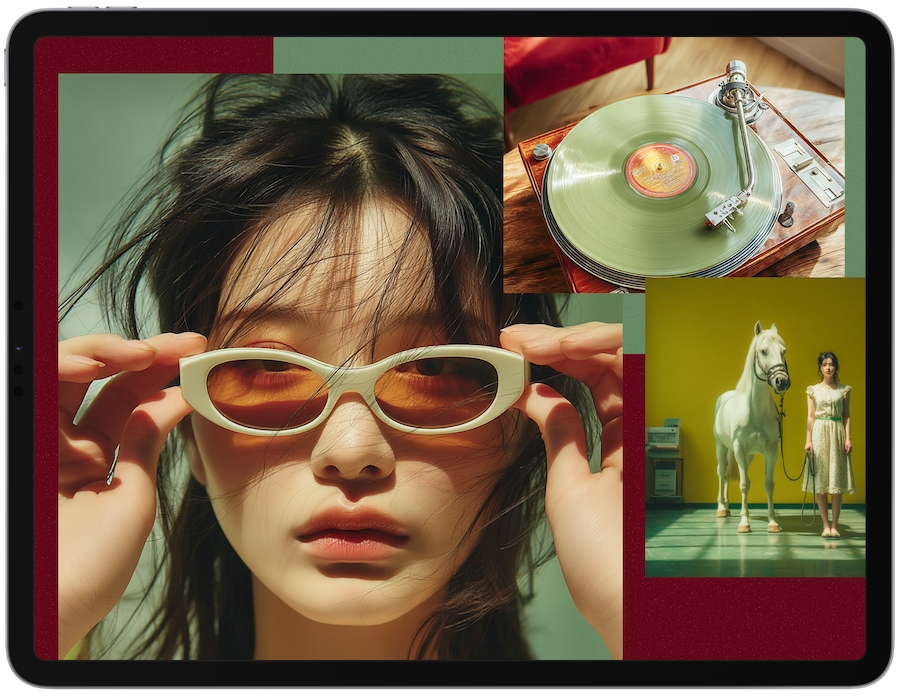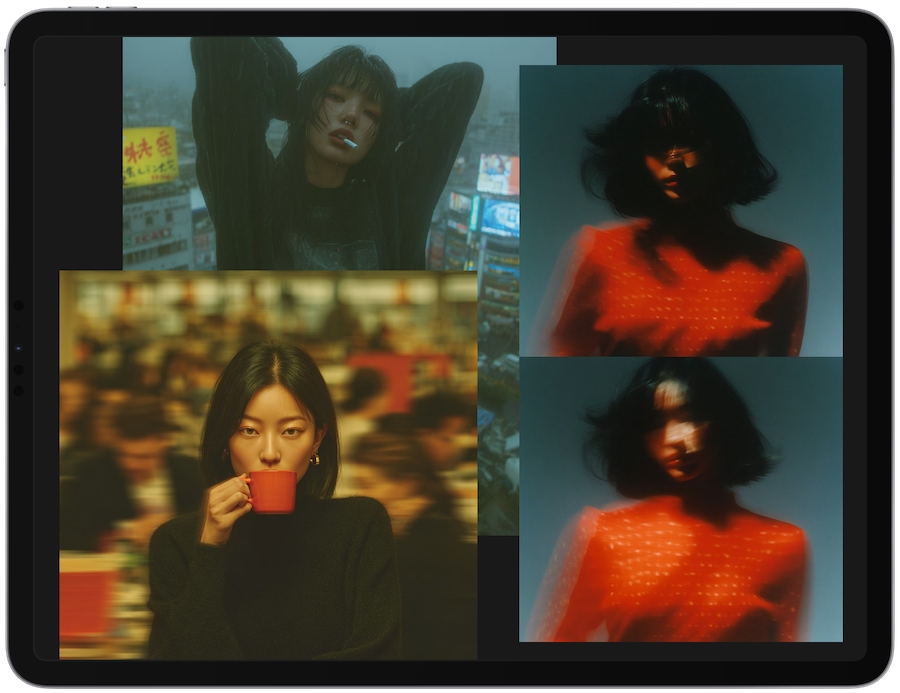
Everyone asks whether AI will replace musicians. It’s the wrong question. The interesting one is what you can now build that was impossible in the real world.
I built a complete virtual artist in about 72 hours: name, backstory, brand voice, visual identity, a full set of photoshoots. Not to fake anything, but to test an idea I’ve had for a while: that fictional characters might be one of the most useful marketing tools an independent musician has. This guide is the exact four-step system I used, prompts included.
Why a fictional artist at all
You’re competing for attention, not just on talent. Gorillaz understood that in 2001: virtual band members, endless creative possibilities, no ego conflicts, no scheduling problems. Back then it needed a major label’s budget. Now it needs a couple of AI tools and a clear idea.
The breakthrough isn’t the technology. It’s the freedom. A virtual artist can:
- Exist in any visual style you want
- Never have a bad day on a photoshoot
- Embody concepts a real person couldn’t pull off
- Carry a mythology that isn’t limited by anyone’s actual life
- Scale content without anyone burning out
Most musicians struggle with their image, their consistency, their visual identity. A virtual artist doesn’t have those problems, because every one of those decisions was made deliberately, once, in writing.
Step 1: the foundation, in Claude
Build the character’s DNA before anything visual. Give Claude this:
I’m creating a fictional music artist. Help me develop the following.
CHARACTER FOUNDATION:
- Name and origin story
- Core personality traits and motivations
- Musical style and influences
- Visual aesthetic and colour palette
- Backstory that connects to my actual music themes
BRAND ARCHITECTURE:
- Key messaging and brand voice
- Content themes and narrative threads
- Visual style guidelines
- Fan engagement strategies
Make this feel like a real person with real depth, not a marketing gimmick.
Read the output and push back. Change the name, shift the aesthetic, ask for more contradiction in the personality. Keep prompting until the character feels like someone you’d want to follow.
Then make a copy of the ThorneLabs Artist Blueprint, add it to your Claude project knowledge or attach it to the chat, and ask:
Based on the virtual artist we have developed, let’s complete all the sections in the ThorneLabs Artist Blueprint attached below.
You now have a full brand document for a person who doesn’t exist. It’s the same document a real artist should have, which is the point: the free Artist DNA template does this job for a human act.
Step 2: photography direction, in ChatGPT
Turn the profile into image prompts. Paste the character output and ask:
Based on this character profile, create 5 detailed Midjourney prompts for:
- Portrait or headshot for social media
- Performance or concert scene
- Studio or creative environment
- Lifestyle or candid moment
- Album cover concept
Include specific details about lighting techniques, colour palettes, styling elements, camera angles, and mood and atmosphere. Make each prompt cinematically compelling and brand-consistent.
The value here is specificity. A model writing image prompts from a rich character profile produces direction a photographer would recognise: lens, light, material, mood.
Step 3: the visual world, in Midjourney
Generate until one image is undeniably the character. That becomes the anchor for everything after.
Consistency is the whole game, and Midjourney gives you the tools for it:
--sref [reference image URL]locks the style across generations--cref [character reference URL]locks the face and figure- Lighting language that’s specific: “golden hour rim lighting”, not “good lighting”
- Material detail: “vintage denim jacket, worn leather boots”, not “cool outfit”
Two of the images from my character’s world, with the prompts that made them:
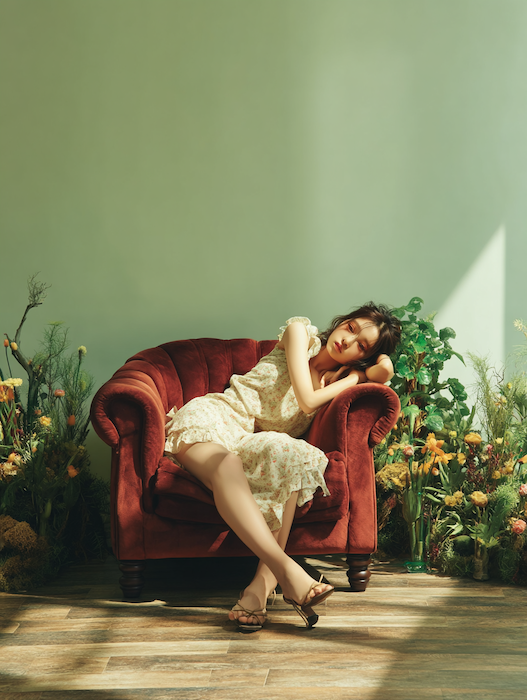
Wide shot of Japanese girl in vintage floral dress laying languidly draped across oversized deep crimson red velvet armchair, her body gracefully positioned with one arm trailing over the chair’s edge, against same sage green wall background, lush green plants and delicate flowers arranged behind and around the chair creating botanical backdrop, rich burgundy velvet fabric creating bold color contrast, late afternoon golden sunlight streaming across the scene creating warm pools of light and soft shadows, same wooden floor planks visible, dreamy film photography aesthetic with vintage grain, muted green and earth tone color palette with one striking crimson element, contemplative and melancholic atmosphere, shot from distance to show full chair and figure surrounded by greenery, soft natural lighting mixing with warm afternoon sun, same nostalgic photoshoot mood with dramatic visual impact, vintage film look with soft focus areas, luxurious velvet texture contrasting with natural botanical elements
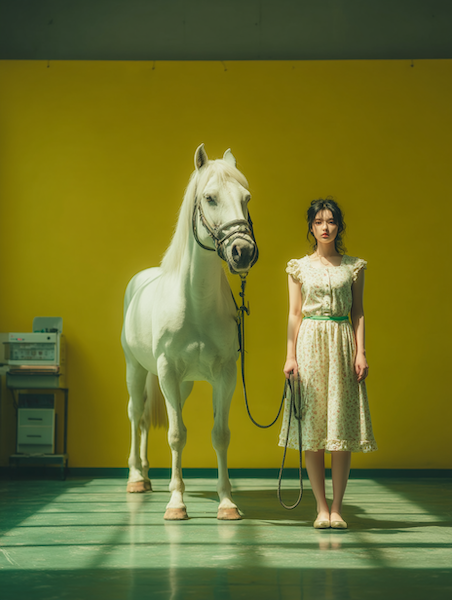
Wide angle shot of Japanese girl in short sleeve vintage floral dress standing in photography studio holding reins of elegant white horse, sage green infinity wall background creating seamless curved backdrop, white horse positioned side-on in profile while girl faces camera with contemplative direct gaze, strong afternoon sunlight streaming through large studio windows creating dramatic lighting and long shadows across polished concrete studio floor, dreamy film photography aesthetic with vintage grain, muted sage green backdrop with bright white horse creating striking contrast, professional studio setting with high ceilings and minimal equipment visible, contemplative and surreal atmosphere, shot from distance to show full scene and scale, vintage film look with soft focus areas, ethereal mood mixing natural light with studio environment, same nostalgic photoshoot aesthetic elevated to fine art photography setting
Notice the phrases that repeat: “same sage green wall”, “same nostalgic photoshoot mood”, “vintage film look with soft focus areas”. That repetition, plus the reference parameters, is what makes a set of images read as one artist’s world rather than a mood board.
Step 4: release under the persona
With the character, the brand document and the visual world in place, the music goes out like any other release: the same three phases, the same pre-release campaign, the same platforms. What’s different is that every asset already matches, because the rules were written before the first image existed. Release Music Like a Pro covers the mechanics.
Two things to get right. Be clear with your audience about what the project is; the point of a virtual artist is the creative freedom, not deception, and audiences respond well to a persona presented as one. And check your distributor’s rules on AI-generated content: the visuals here are generated, the music isn’t, and platforms increasingly ask about both. On Music and Artificial Intelligence has the 2026 picture.
What this is really about
Virtual artists don’t compete with real musicians. They compete with boring marketing.
The tool doesn’t make the art. The vision does. What’s changed is that the vision no longer needs a label’s budget to be realised. A visual world that would have cost a photographer, a stylist, a location and a week now costs an idea, a brand document, and a weekend of generating until it’s right.
The future of music marketing isn’t humans versus AI. It’s humans with the tools against humans without them.
The prompts
I put many of the prompts I used for this character’s images and videos into a free pack: the Advanced Prompt Pack Vol. 1. The Secret Midjourney Prompts Vol. 1 pack is the visual side, and if you’d rather have a tool write the Midjourney prompt from a reference image, the Visual Prompt GPT does exactly that.
Frequently asked questions
What is a virtual artist?
A fictional musical persona with its own name, story, look and voice, built to front real music. Gorillaz did it in 2001 with animation and a label's budget. In 2026 it can be done with a language model for the character and brand, an image model for the visuals, and a weekend. The music is still made by people; the character is how it's presented.
How do you create a virtual artist with AI?
Four steps. Build the character's foundation and brand in a language model such as Claude, working from a structured brief. Turn that profile into photography direction, with a model like ChatGPT writing detailed image prompts for portraits, performance, studio, lifestyle and cover art. Generate the visuals in Midjourney, using style and character reference parameters for consistency. Then release music under the persona with the same story and look everywhere.
How do you keep a virtual artist visually consistent?
Pick one strong reference image early and use it as the anchor. In Midjourney, the style reference and character reference parameters lock the look and the face across generations. Describe lighting, materials and colour specifically rather than vaguely, and keep a written style guide so every new image starts from the same rules.
Is a virtual artist a gimmick?
It can be, if the character is thin. It isn't when the persona is built with real depth and connected to the themes of the music. Virtual artists don't compete with human musicians. They compete with boring marketing, and they give an artist creative freedom a real photoshoot can't: any world, any style, no bad days on set.